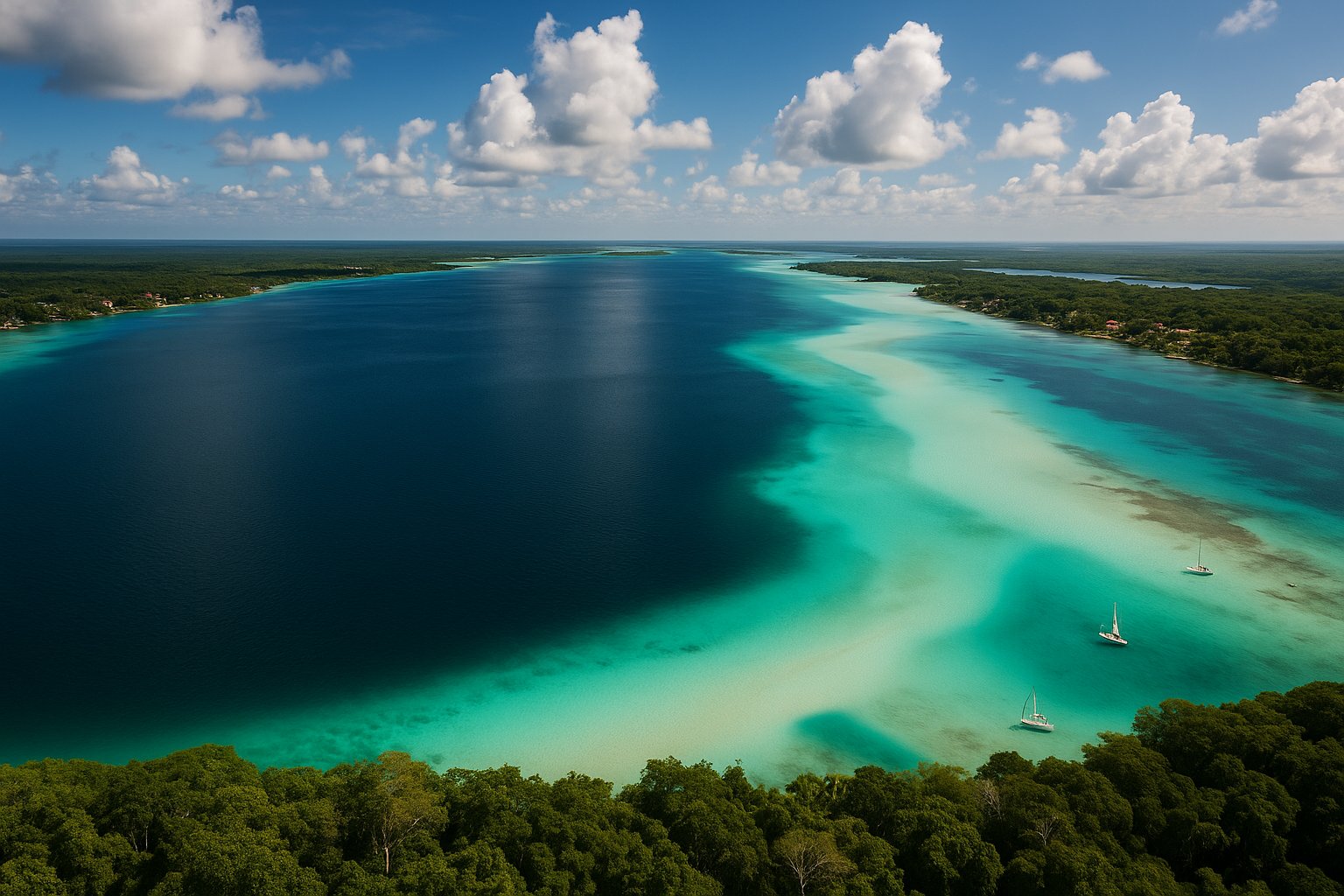
Bacalar has no sargassum: its freshwater lagoon is the answer for anyone seeking sargassum-free waters, turquoise year-round, to visit or to live.
Sargassum in the Caribbean: Understanding the Phenomenon Without the Alarm
Sargassum is a marine macroalga that floats in the open ocean and has been part of the Atlantic ecosystem for centuries: it shelters fish, turtles, and crustaceans, and drifts thousands of kilometers on the currents. What has changed the conversation in the Caribbean is something else entirely: in recent years, huge masses of the algae have been breaking away from their usual route and arriving in waves — the influxes known locally as arribazones — on the region's coasts, from the Antilles to Quintana Roo. When it reaches land, the algae piles up along the shore, stains the water in brownish tones and, as it decomposes under the sun, gives off a smell that has little to do with the Caribbean postcard. It is not a permanent catastrophe, but it is a reality that beach destinations have learned to live with.
What matters is understanding its nature: sargassum is seasonal and deeply variable. It tends to intensify in the warm months, between spring and summer, and taper off toward winter, but every year is different and so is every beach. A shoreline can wake up clean one morning and blanketed the next, depending on wind and current; one bay may be spared while the beach next door receives tons. Coastal destinations have responded with offshore barriers, collection vessels, and cleanup crews that work every single day, and there are entire seasons when the sea looks splendid. None of this is cause for doom-mongering, but it does introduce something uncomfortable for anyone planning a vacation — or a home — by the sea: uncertainty.
Because that, in the end, is the real cost of sargassum: it doesn't ruin the Caribbean, but it makes its central promise unpredictable. The traveler who books months in advance doesn't know whether they'll find the turquoise water of the photographs or a ribbon of algae along the shore; the host renting out a beachfront home depends on satellite monitoring and daily reports to know what product they're offering that week. The experience can still be magnificent — the Mexican Caribbean is — but it hangs on a variable no one controls. And it is precisely against that uncertainty that Bacalar offers something no coastal destination can promise: certainty.
Why There Is No Sargassum in Bacalar: Freshwater, Inland
The short answer is emphatic: there is no sargassum in Bacalar's lagoon because there cannot be. Sargassum is a marine alga; it lives, reproduces, and travels in salt water, pushed by ocean currents. Bacalar's lagoon, by contrast, is a freshwater body roughly 42 kilometers long, set inland and fed by springs and cenotes that well up from the Yucatán Peninsula's network of underground rivers. There is no ocean current that could carry the algae here, and no conditions in which it could survive if it arrived. The famous Lagoon of Seven Colors shares nothing with the Caribbean Sea but its palette of blues; in everything else — chemistry, origin, dynamics — it is another world.
It's worth underscoring how different this is from what happens on the coast. Caribbean beaches fight sargassum with effort and resources: floating barriers, heavy machinery, crews at dawn. It is admirable work, but it is exactly that — work: a defense against an external phenomenon that returns each season with a different force. Bacalar doesn't need to defend itself, because its immunity depends on no infrastructure and no budget; it is structural, geographic, permanent. There is no 'sargassum season' on the lagoon, good or bad, and there never will be. In a region where the Caribbean traveler's biggest question has become 'what will the beach look like that week?', Bacalar is one of the few places where the question simply doesn't apply.
That freshwater condition also explains everything else that makes the lagoon unique: the extraordinary clarity that lets you see the bottom several meters down, the hues that shift from aquamarine to cobalt blue with the depth, and the ancient stromatolites — living structures built by microorganisms that rank among the oldest life forms on the planet and thrive only in water of exceptional purity. The same geographic fact that keeps sargassum out is the one that sustains the entire spectacle.
Turquoise 365 Days a Year: What It Means for the Traveler
The practical consequence is easy to state and hard to overstate: in Bacalar, turquoise water is guaranteed every day of the year. Whoever books in May finds the same thing as whoever books in November: a transparent, swimmable lagoon with those seven colors that change with the light but never with the season. For tourism, this makes Bacalar a destination with no fine print. Sailboat and kayak outings, the swimming spots and wooden piers that stand in for a beach, sunrise over still water: none of it is contingent on a sargassum report. Bacalar is a Pueblo Mágico, and much of its magic lies precisely in that constancy.
Added to that certainty is a level of connectivity that was unthinkable just a few years ago. The Tren Maya now runs with a station in Bacalar, Tulum's international airport shortens the trip from abroad, and Chetumal — the state capital, with its own airport — is some 30 to 40 minutes away by road. From Cancún, the drive takes around four and a half to five hours, a trip many turn into a scenic route down the coast. And close by, the recently opened Ichkabal archaeological site adds a monumental dimension to southern Quintana Roo. A destination that once demanded an explorer's resolve can now be reached by train, plane, or highway — without losing its human scale.
The result is a different kind of trip from the resort Caribbean: slower, closer to the water and the jungle, with the town of Bacalar as the center of daily life — restaurants, a colonial fort, a lakeside promenade — and the lagoon as the undisputed protagonist. Toward the southern end, where the water reaches its greatest depth and its most serious blues, the village of Xul-Há marks the close of the lagoon and the gateway to its quietest stretch. It's the part returning travelers tend to discover on their second visit — and the one many no longer want to leave.
What It Means for Buyers: Rentals and Everyday Life
For anyone weighing a purchase with vacation rentals in mind, the absence of sargassum changes the terms of the analysis. A host on the coast offers a product tied to a seasonal variable beyond their control: the same property can be photographed against a turquoise sea in January and a brown ribbon in June, with everything that implies for reviews, cancellations, and guest expectations. In Bacalar, the core asset — the seven-color water — is constant. The experience promised in the listing is the one guests find when they arrive, any week of the year. That predictability doesn't guarantee any return on its own, but it removes one of the most talked-about risks in Caribbean lodging and makes it possible to plan a year-round operation with no seasons written off in advance.
For anyone thinking about living here — full-time or for long stretches — the logic is even simpler: nobody wants their quality of life to hinge on a satellite report. Living beside the lagoon means swimming in clean water any morning of the year without checking anything first. The southern lagoon also offers a rare balance: the calm of the deepest, quietest part of the water, with the town of Bacalar and its services about 15 minutes away, Chetumal a good half hour out for errands, hospitals, and flights, and the Tren Maya as an alternative for getting around the peninsula. It's the equation sought by those who want to retreat from the noise without retreating from the world.
The Commitment the Lagoon Asks in Return
It would be incomplete to celebrate Bacalar's immunity to sargassum without saying what comes with it: the lagoon is not invulnerable — it is simply vulnerable to other things. Its balance depends on the purity of the water rising from the cenotes, on a limestone bed that must not be disturbed, and on the stromatolites, which took millennia to form and do not regenerate on a human timescale. The real threats don't come from the sea but from the land: untreated wastewater, indiscriminate clearing, careless construction along the shore. Bacalar demands no barriers against an alga; it demands responsibility from those who visit it and, above all, from those who choose to build beside it.
That commitment translates into very concrete terms. For the visitor: enter the water without conventional sunscreen — or only with genuinely biodegradable formulas — don't step on or touch the stromatolites, don't drop anchor on the lagoon bed, and go out with responsible operators. For real estate development: treat one hundred percent of its wastewater, preserve as much jungle as possible, build at low density and set back from the shoreline, and understand that the value of any property in Bacalar is literally dissolved in the lagoon's water. Protecting that balance is no decorative environmental gesture: it is the only way the privilege of a sargassum-free Caribbean keeps existing for the next generation.
The Southern Lagoon: Where Certainty Becomes Home
If Bacalar is the Mexican Caribbean without sargassum, the southern lagoon is its purest expression: the deepest water, the most intense blues, the least crowded shoreline, with Xul-Há closing the mirror of water and the town a quarter of an hour away. It's the zone that pairs the certainty of perpetual turquoise with a silence now scarce across the rest of the Caribbean — which is why it draws the attention of those looking for more than a visit: a place where the landscape doesn't change with the season or the luck of the currents.
There, on that southern shore, The Reserve Bacalar is taking shape: a private residential community conceived around conservation, with an international-caliber hotel immersed in rivers created within the development, a Day Club with direct access to the lagoon, Branded Residences, and lots from 200 square meters for those who prefer to build at their own pace. It is not a project that promises beaches — it promises something rarer: turquoise water every day of the year, and the commitment to keep it that way. In a Caribbean that has learned to eye the sea with caution, being able to look at the lagoon with certainty may be the truest luxury.
Frequently asked questions
Is there sargassum in Bacalar?+
No — and there can't be. Sargassum is a marine alga that lives in salt water and reaches the coast carried by ocean currents. Bacalar's lagoon is a freshwater body some 42 kilometers long, set inland and fed by cenotes and springs, so the algae has no way to get there and no conditions to survive. The turquoise water stays stable all year long.
When is sargassum season in the Mexican Caribbean?+
On the coastal beaches, sargassum tends to intensify in the warm months, roughly between spring and summer, and ease off toward winter, though it varies widely by year, wind, and each particular beach. In Bacalar the question doesn't apply: as an inland freshwater lagoon, it has no sargassum season — high or low.
Does Bacalar have a beach?+
Bacalar has no ocean beach: its draw is the Lagoon of Seven Colors, freshwater and crystal clear. Instead of sand and surf there are swimming spots, wooden piers, and light-bottomed shores where the water is calm and swimmable all year. For many travelers, that combination of turquoise water with no waves and no sargassum is actually more comfortable than a traditional beach.
How do I get to Bacalar, and how far is it from Cancún?+
There are several routes: the Tren Maya runs with a station in Bacalar, Tulum's international airport now receives flights and shortens the trip, and Chetumal, with its own airport, is about 30 to 40 minutes away by road. From Cancún's airport, the highway drive takes between four and a half and five hours.
Can you swim in Bacalar's lagoon all year round?+
Yes. Being freshwater, with no heavy surf and no sargassum, the lagoon is swimmable 365 days a year. That said, you should enter without conventional sunscreen — or only with genuinely biodegradable formulas — and avoid stepping on the stromatolites or stirring up the bottom, to protect the ecosystem that makes the water's clarity and seven colors possible.
Live Bacalar front-row
Discover The Reserve, a luxury community in the south of the Lagoon of Seven Colors.
Discover the project