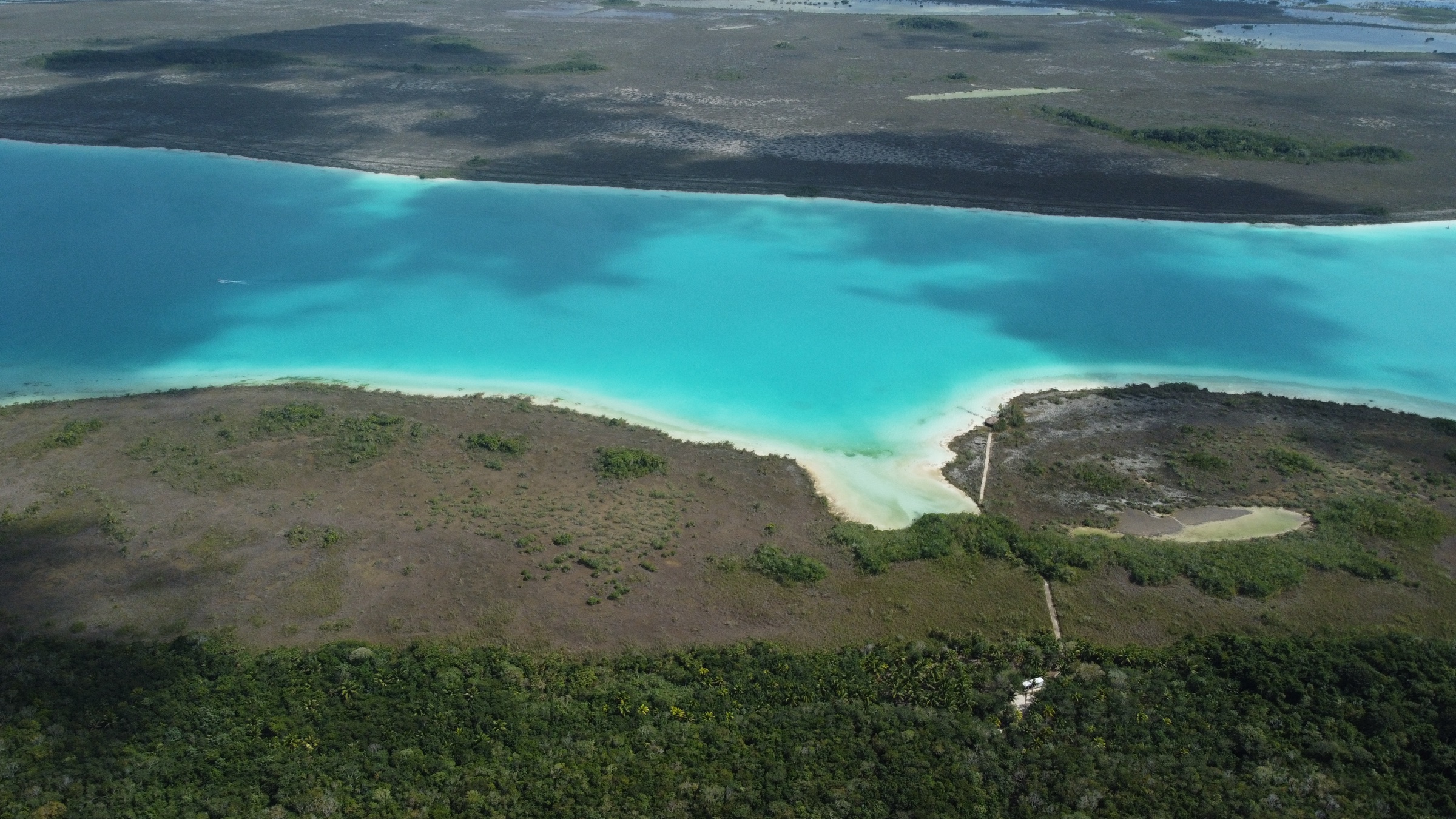
What the stromatolites of Bacalar are, why the lagoon holds one of the world's largest colonies, and how to visit them without causing harm.
What stromatolites are and why they matter
Stromatolites are structures built by communities of microorganisms, mainly cyanobacteria, that trap sediment and minerals layer by layer until they form rocky structures that grow very slowly over centuries. They are not stones or corals in the usual sense: they are living microbial reefs, and they represent one of the oldest known forms of life on Earth. Their fossil relatives appear in the geological record from billions of years ago, long before plants or animals existed.
What makes Bacalar extraordinary is that here we are not talking about lifeless fossils, but about colonies that are still alive and active today. That is why they are called living fossils: they are a direct window onto the early planet, an ecosystem that works much as it did when life was just beginning. Seeing them up close is like glimpsing a very early chapter in the history of life, written in structures that grow before your eyes at an almost imperceptible pace.
That slowness is precisely what makes them so fragile. A formation that took decades or centuries to build can be broken in an instant by a single footstep or knock. Understanding what they are helps explain why Bacalar asks for so much care when you visit them.
Why Bacalar has one of the largest colonies
The Laguna de los 7 Colores brings together an uncommon combination of conditions. Its clear, mineral-rich freshwater, its white limestone bottom, and the intense Caribbean light create an ideal environment for cyanobacteria to thrive and build stromatolites on a large scale. The result is one of the world's greatest concentrations of these structures in freshwater, spread across much of the lagoon's roughly 42 kilometers.
These formations are especially visible where the water is shallow and transparent, such as at Los Rápidos, the gentle-current natural channel near Xul-Há at the southern end, where the lagoon narrows toward Laguna Mariscal. There the stromatolites form genuine walls and platforms just beneath the surface, easy to admire without ever touching them.
The fact that Bacalar still holds such an extensive colony is neither accidental nor guaranteed: it depends on the water staying clean, low in polluting nutrients, and free of chemicals. Every individual act of care helps these ancient structures keep growing.
Their role in the water and the life of the lagoon
The cyanobacteria that form stromatolites carry out photosynthesis, just like plants, and in the process they release oxygen. On a planetary scale and across vast stretches of time, it was organisms much like these that helped transform the early atmosphere and fill it with the oxygen that made life as we know it possible. Watching them in Bacalar is like seeing, on a small scale, a process that changed the world.
In today's lagoon they also serve very concrete functions. By fixing calcium carbonate and building their structures, they take part in the chemical balance of the water and help maintain the clarity and the luminous tones for which Bacalar is famous. In a sense, they are part of the engine that gives the Laguna de los 7 Colores its character.
That is why protecting them is not only a matter of preserving a biological curiosity. It means caring for one of the elements that sustain the health and beauty of the entire lagoon system.
How to visit them responsibly
The main rule is simple and non-negotiable: never touch, step on, or lean against the stromatolites. Although they may look like solid rock, their living surface is extremely delicate and the damage is usually irreversible. Keep a sensible distance when swimming or floating near them, and avoid stirring up sediment with your fins or feet.
Sunscreen and insect repellent are another critical point. Their oils and chemicals dissolve in the water and harm these sensitive organisms, so the ideal is to enter the lagoon with nothing on your skin or, if you need protection, to choose a long-sleeved swim shirt and a hat instead of creams. Many responsible operators in the area ask visitors not to wear sunscreen before getting in the water, and it is always worth respecting that.
Beyond this, the usual good practices for any fragile ecosystem apply: leave no trash behind, never use soap or shampoo in the lagoon, and follow the guidance of local guides, who know the most sensitive areas. Visiting the stromatolites with this awareness is part of what it means to enjoy the south of Bacalar: a place where nature sets the pace, and where living close to the water means, above all, taking care of it.
Frequently asked questions
What exactly are the stromatolites of Bacalar?+
They are structures built by microorganisms, mainly cyanobacteria, that trap minerals and grow very slowly, forming living reefs. They are among the oldest forms of life on Earth, and in Bacalar they are still active, which is why they are called living fossils.
Can you touch or walk on the stromatolites?+
No. Their living surface is very fragile and the damage is essentially irreversible, even though they may look like solid rock. The right approach is to observe them without touching, keep your distance while swimming, and never step on or lean against them.
Why shouldn't you wear sunscreen when visiting them?+
The oils and chemicals in sunscreen and repellent dissolve in the water and harm these sensitive organisms. It is best to enter with nothing on your skin and protect yourself with long-sleeved clothing and a hat instead.
Live Bacalar front-row
Discover The Reserve, a luxury community in the south of the Lagoon of Seven Colors.
Discover the project