Nature
The Wildlife of Bacalar: Birds, Monkeys and Manatees of Jungle and Lagoon
Toucans, motmots, howler monkeys, agoutis, coatis, manatees and crocodiles share the mosaic of jungle, mangrove and freshwater that surrounds the Lagoon of Seven Colors. A guide to recognizing them and observing them respectfully.
A meeting of jungle, mangrove and freshwater
Bacalar is not a single landscape but the meeting of several. The Lagoon of Seven Colors rests on a limestone bed and shelters living stromatolites — structures built by cyanobacteria that rank among the oldest life forms on Earth — while its shores are woven with red, white and buttonwood mangroves. Inland begins the medium-height jungle of the Yucatán Peninsula, dotted with deep cenotes such as Cenote Azul. That diversity of habitats, all adjacent to one another, is why the local wildlife is so varied.
Each environment supports different species that often blend along the edges. The mangrove acts as a nursery for fish and crustaceans, filters sediment and shelters water birds and the Morelet's crocodile. The jungle feeds primates, rodents and a remarkable community of fruit-eating birds. The lagoon, with its clear freshwater, offers calm corridors through which the manatee moves. Understanding that these systems are connected helps you observe better: the richness of Bacalar lives in the transitions, not in any single postcard spot.
It is worth remembering that much of this wildlife is naturally elusive. This is not a zoo or an aquarium: animals appear and disappear depending on the hour, the season and the weather. Patience, silence and a local guide who knows the terrain completely change the experience and, above all, reduce the impact on the animals.
Birds: toucans, motmots and endemic species
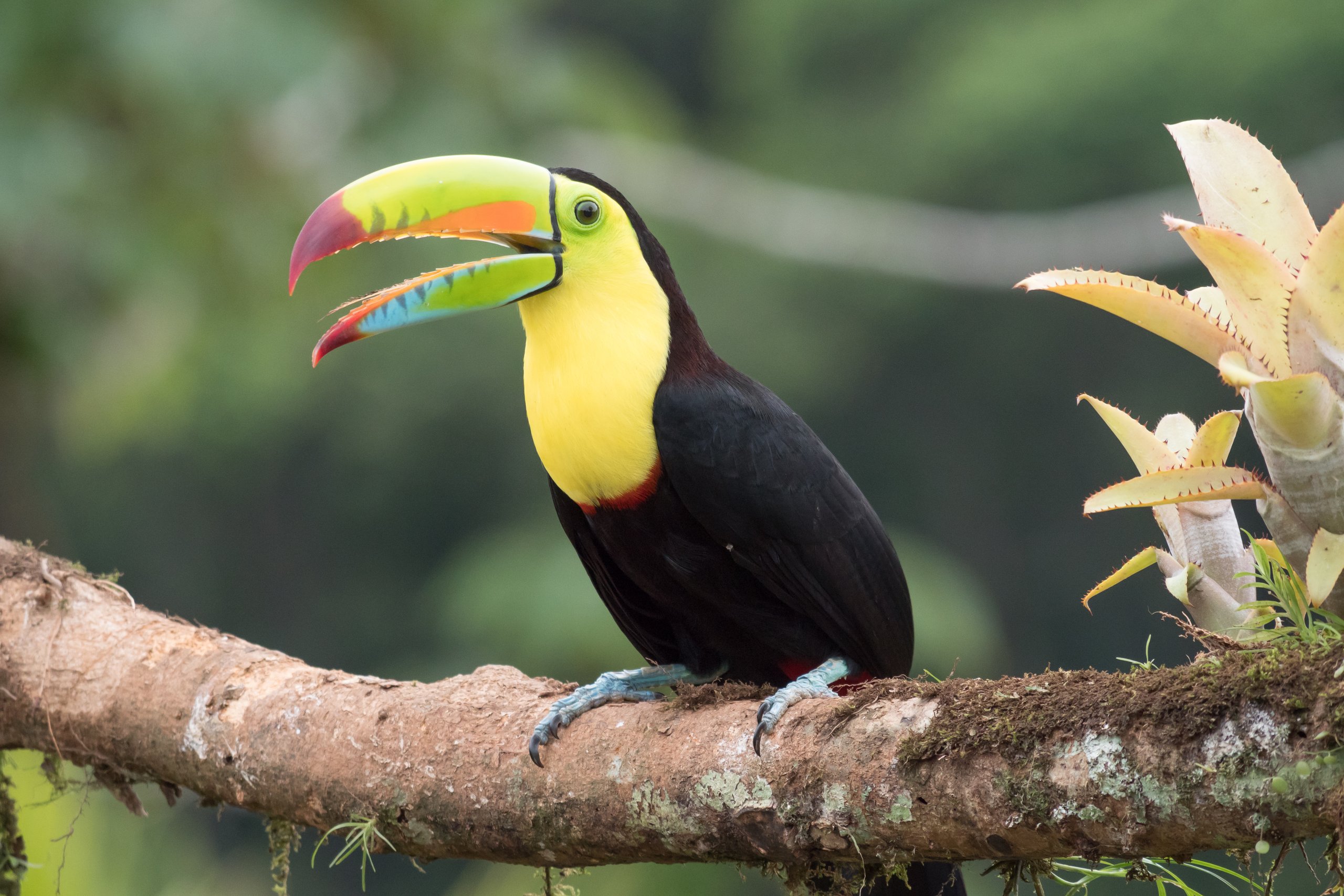
The Yucatán Peninsula is one of Mesoamerica's great birdwatching destinations, with more than 200 species documented in the region and around twenty endemics or near-endemics. In the jungle around Bacalar, the keel-billed toucan (Ramphastos sulfuratus) is the star: its enormous multicolored bill and undulating flight make it unmistakable as it crosses a clearing at dawn or perches in fruiting trees. Striking as it is, it is usually detected by its call before it is seen.
The turquoise-browed motmot (Eumomota superciliosa), known in Maya as toh and popularly as the clock bird for the pendulum-like swing of its tail, is another emblem. It nests in the limestone walls of cenotes and ravines, and its flash of turquoise in the forest gloom is one of the most sought-after sightings. It is joined by other motmots and a long list of hummingbirds, doves, cuckoos, tanagers and woodpeckers that give the forest its sonic texture.
Over the lagoon and mangrove the cast shifts toward water birds: herons, the roseate spoonbill, the snail kite — specialized in freshwater snails — kingfishers and mangrove swallows. In season, migratory birds from the north join the mix. For beginners, it pays to head out early, bring binoculars and not expect to see everything in a single morning; birdwatching rewards persistence and stillness.
Jungle mammals: monkeys, agoutis and coatis
Two primates inhabit the best-preserved jungles of southern Quintana Roo. The Yucatán black howler monkey (Alouatta pigra) rarely shows itself, but its deep, resonant roar — audible for miles at dawn and before rain — is one of the most memorable sounds of the Maya jungle. The spider monkey (Ateles geoffroyi), agile and prehensile-tailed, moves through the canopy in groups and is one of the largest primates in the New World. Both depend on continuous stretches of forest and are sensitive to habitat fragmentation.
At ground level appear mammals that are more discreet but no less important. The agouti — locally called sereque (Dasyprocta) — is a daytime rodent the size of a large rabbit that plays a key ecological role: it buries seeds and later forgets them, dispersing trees and helping the jungle regenerate. The coati (Nasua narica), a relative of the raccoon, travels the forest floor in bands with its long snout and upright tail, foraging through the leaf litter for insects and fruit.
The region's mammal list also includes more reclusive species such as the white-nosed coati's cousins, the armadillo, the opossum and elusive cats like the ocelot and the jaguarundi. They are almost never seen by day, but their presence confirms the health of the ecosystem. For the visitor, the realistic pleasure lies in howlers, agoutis and coatis, and in understanding that the large carnivores are part of a web better protected than chased with a camera.
Manatees and crocodiles: the giants of the water
The Antillean manatee (Trichechus manatus) is perhaps the most endearing and vulnerable resident of the lagoon system. This enormous herbivorous mammal, which can exceed three meters, moves slowly through calm channels and mangrove zones between Bacalar, Chetumal Bay and the border with Belize, where a sanctuary is dedicated to its protection. It is listed as an endangered species: it has no natural predators, but it is highly sensitive to boat collisions, engine noise and habitat loss. Seeing one is a matter of luck and should always happen from a distance.
The Morelet's crocodile (Crocodylus moreletii) is the other giant, and it is worth knowing well so you can coexist with it without fear or recklessness. It is a native species that inhabits lagoons, mangroves and channels across the peninsula; it usually reaches about three meters and prefers mangrove zones for nesting. Recent studies in the lagoon confirm a low but stable population of just a few individuals. It is not aggressive by nature, but feeding it or approaching too closely alters its behavior and creates conflict.
Coexistence with these animals is entirely possible by following simple rules: do not swim at dusk or at night in mangrove areas, never feed crocodiles, keep your distance from the young and respect local signage. Far from being a threat, manatees and crocodiles are indicators of a healthy freshwater system: their presence is good news for Bacalar, not cause for alarm.
How to observe wildlife responsibly
The golden rule is not to interfere. Observing means looking without touching, without feeding and without disturbing: feeding a wild animal changes its behavior, makes it dependent and, in the case of crocodiles, dangerous. Keep your distance, use binoculars or a telephoto lens instead of approaching, lower your voice and stay quiet. The best sightings happen at dawn and dusk, when wildlife is most active and the heat eases.
On the water, care is doubly important. Avoid conventional sunscreens and repellents, which pollute the lagoon; choose biodegradable options or, better still, physical protection such as clothing and a hat. Do not touch or step on the stromatolites: they are living organisms that die on contact and that help keep the water clean. Keep boats at low speed in mangrove zones to avoid harming manatees or stirring up sediment, and leave no trash or waste on the shores.
Finally, choose certified local guides and operators who respect the good-practice guidelines of Bacalar's Ecology Directorate and of nearby protected areas, such as the Sian Ka'an Biosphere Reserve or the manatee sanctuary. A good guide will not promise that you will see a manatee or a toucan — no one can guarantee that — but will teach you to find them while respecting their space. That, in the end, is the richest and most lasting way to come to know the wildlife of Bacalar.
Frequently asked questions
Can you see manatees in the Bacalar Lagoon?+
Yes, although sightings are difficult and never guaranteed. The Antillean manatee moves through calm channels and mangrove zones between Bacalar, Chetumal Bay and the Belize border, where a sanctuary exists. It is an endangered species and highly sensitive to noise and boats, so it should always be observed from a distance and never pursued.
Are there crocodiles in Bacalar? Is it dangerous to swim?+
Yes, the Morelet's crocodile (Crocodylus moreletii) lives in the mangroves and channels — a native species with a low but stable population. It is not aggressive by nature. Swimming in the open, busy areas of the lagoon during the day is generally safe; it is wise to avoid mangrove zones at dusk and at night, never feed crocodiles and respect local signage.
What is the best time and season to watch birds and wildlife in Bacalar?+
Dawn and dusk are the best moments: wildlife is most active and the heat is lower. For birds, head out early with binoculars. Migratory birds from the north are usually seen during the winter season, while many resident species can be observed year-round. Patience and silence matter more than any specific date.
What animals can I expect to see on a typical visit?+
You are most likely to hear or see keel-billed toucans, turquoise-browed motmots, herons and kingfishers, along with agoutis (sereques) and coatis on the forest floor. Howler monkeys are often heard even when hard to see. Manatees, crocodiles and cats such as the ocelot are far rarer sightings and depend on luck, the area and a good guide.
Live Bacalar front-row
Discover The Reserve, a luxury community in the south of the Lagoon of Seven Colors.
Discover the project