Destination
Ichkabal: The Monumental Maya City Near Bacalar You Can Now Visit
Less than an hour from the Lagoon of Seven Colors, Ichkabal opened to the public in 2025 after decades of study. Here is the full guide to its scale, its history, and how to visit it respectfully.
A city that slept beneath the jungle
For centuries, one of the largest Maya cities in southern Quintana Roo lay hidden in the jungle, a short distance from Bacalar. Ichkabal was formally documented by Mexico's National Institute of Anthropology and History (INAH) in the late 1990s, but opening it to the public took far longer: the archaeological zone officially opened its doors on January 13, 2025, as part of the Archaeological Zone Improvement Program (Promeza) tied to the Maya Train.
Its name says a great deal about the place. In Maya, Ichkabal is read as "between lowlands": from ich, "between," and kabal, "lowlands" or wetlands. The city was built on high ground surrounded by seasonal floodplains, the moist soils its inhabitants used for farming and for capturing water. That intimate relationship with water, so characteristic of this region of lagoons and cenotes, is written into the very heart of the site.
What sets Ichkabal apart is not only its size but its antiquity. It is one of the oldest cities in the Maya area: its first great constructions rose centuries before Chichén Itzá or Uxmal flourished. To visit it is to glimpse an early, foundational stage of Maya civilization, not its twilight.
The scale: pyramids that rise above the jungle
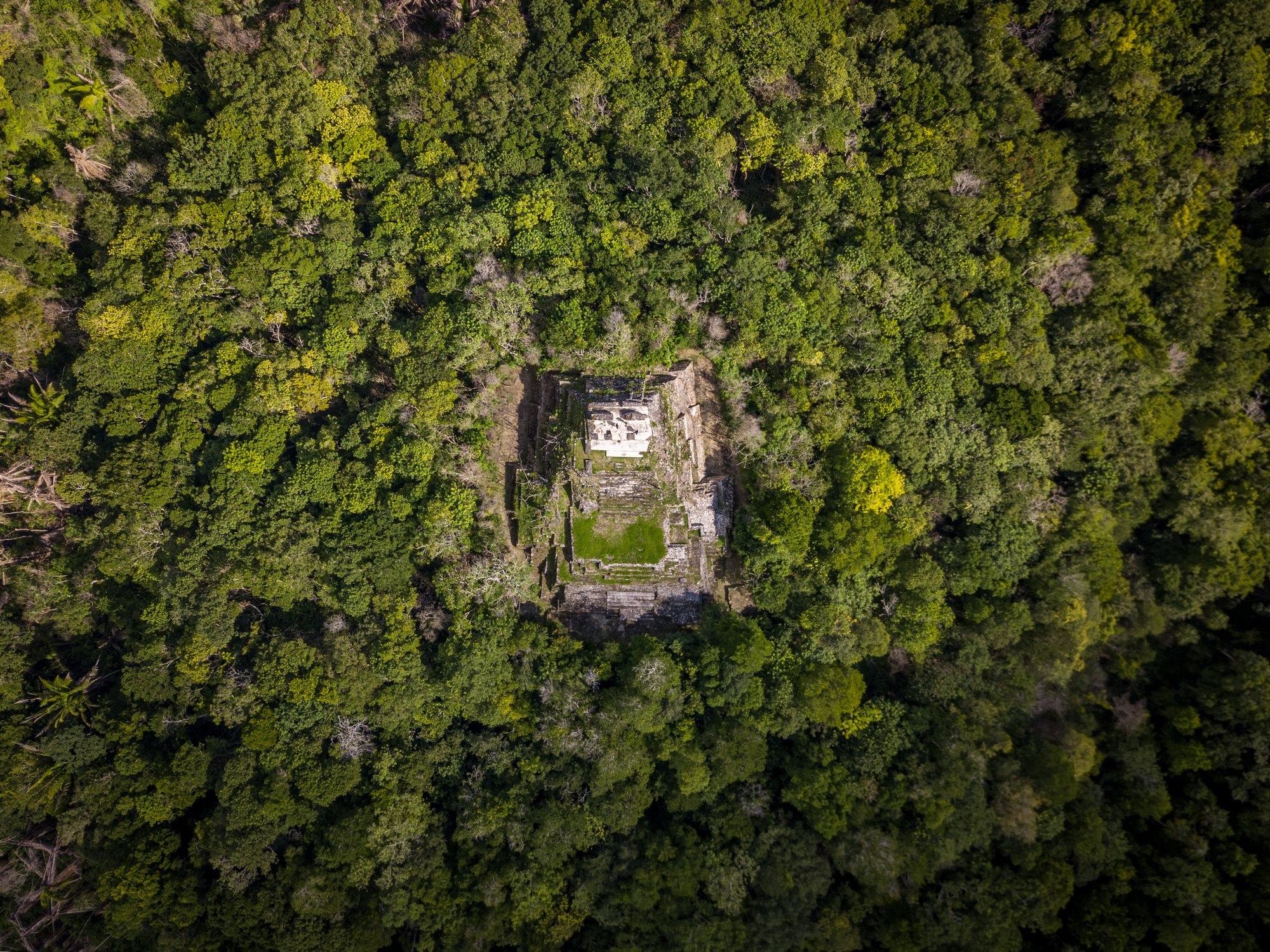
Ichkabal impresses through sheer dimension. The site is organized around a great plaza framed by enormous pyramidal platforms, with six main architectural groups and the triadic complexes typical of the Petén style, in which three temples crown a single raised platform. Several of its structures exceed 40 meters in height and stand above the jungle canopy, a rarity in this cultural region.
The most monumental building has a base roughly 250 meters on a side and reaches around 40 meters in height, a mass comparable in footprint to the great pyramids of Mesoamerica. Beside the main plaza lies an aguada of about one hectare, an artificial body of water that served for water storage and that today is home to crocodiles, earning it the name Aguada de los Cocodrilos (Crocodile Reservoir).
Figures for the total extent vary by source, but the site is consistently described as having a vast monumental core, called by some popular accounts one of the largest in the Maya world. Beyond the numbers, walking through it conveys the feeling of a planned city with a remarkable command of urbanism, hydraulic engineering, and ceremonial architecture.
History: a contemporary of Calakmul and Tikal
Ichkabal's chronology stretches from the Middle Preclassic into the Postclassic, but its period of greatest splendor falls between roughly 200 BC and 200 AD, peaking during the Early Classic (about 200 to 600 AD). In that era it was a contemporary of great capitals such as Calakmul, in Campeche, and Tikal, in Guatemala, and shared in the flowering that defined the high point of Maya civilization.
Its location is no accident. Ichkabal is part of a dense archaeological landscape in southern Quintana Roo that includes nearby sites such as Dzibanché, Kinichná, and Kohunlich. This region was a key stage of early Maya politics, with dynasties weaving alliances and rivalries across the centuries. Specialists are still investigating Ichkabal's exact role within that web of power.
Because of its age and monumentality, some researchers regard it as a site that could help rewrite parts of the region's history. It is wise, though, to treat the more spectacular media claims with caution: much of the site remains under study and excavation, and many interpretations are provisional. That status of a city still in the process of revealing itself is, precisely, part of its allure.
Ichkabal compared to Chichén Itzá
The comparison with Chichén Itzá is inevitable, and it helps put what you see into perspective. Ichkabal's main pyramid, at roughly 40 meters, is nearly twice the height of El Castillo, Chichén Itzá's famous Temple of Kukulcán, which stands around 30 meters. Its monumental core is also described as considerably more extensive than that of Chichén Itzá.
The deeper difference, however, is one of time. Chichén Itzá reached its height between the 9th and 12th centuries AD; Ichkabal was already a consolidated city more than a thousand years earlier. They are not rivals but two distinct chapters of the same civilization: Ichkabal belongs to the monumental origins of the Maya world, while Chichén Itzá represents one of its final great cultural syntheses.
The visitor experience differs too. Chichén Itzá, a World Heritage Site and one of the New Seven Wonders of the World, draws crowds and a developed tourism infrastructure. Ichkabal, by contrast, is walked almost in solitude, surrounded by living jungle where spider monkeys, jaguars, and crocodiles dwell. It is a rawer, quieter visit, for those seeking the thrill of a site only just beginning to open to the public.
How to visit from Bacalar
Ichkabal lies within the municipality of Bacalar, in southern Quintana Roo, about 40 kilometers from the municipal seat according to INAH and relatively close to Chetumal. The most common route from the town of Bacalar combines federal highway with a final stretch of dirt road; plan for roughly one to one and a half hours of travel, depending on your starting point and road conditions. The last stretch is not fully paved, so during the rainy season a high-clearance or four-wheel-drive vehicle is advisable.
Admission is free and, according to INAH, the site is open daily, roughly from 8:00 a.m. to 5:00 p.m. (some local sources note closing around 4:00 p.m., so it pays to arrive early). Visitor facilities are still being developed, so do not expect extensive services: come self-sufficient, with plenty of water, comfortable shoes for walking in the jungle, a hat, sun protection, and biodegradable insect repellent.
Thanks to its proximity, Ichkabal pairs well with other sites in southern Quintana Roo, such as Dzibanché and Kohunlich, to build a one- or two-day archaeological route. And as with any heritage site in the process of opening, the best way to visit is with respect: stay on marked paths, take nothing, protect the wildlife, and leave the place as you found it. Bacalar and its lagoon make the perfect base to rest before or after the adventure.
Frequently asked questions
Is Ichkabal already open to the public?+
Yes. The Ichkabal archaeological zone officially opened to the public on January 13, 2025, after decades of research and preparation led by INAH under the Promeza program associated with the Maya Train. Several earlier opening dates were announced and then postponed before that.
How far is Ichkabal from Bacalar and how do you get there?+
It is in the municipality of Bacalar, about 40 kilometers from the municipal seat according to INAH. You reach it by private car or hired taxi, combining federal highway with a final dirt-road stretch; the trip usually takes one to one and a half hours. There is no direct public transport, and a high-clearance vehicle is preferable in the rainy season.
How much is admission and what are the hours?+
According to INAH, admission is free and the site is open daily, roughly from 8:00 a.m. to 5:00 p.m. (some local sources indicate closing near 4:00 p.m.). It is best visited in the morning, bringing water and sun protection, since visitor services are still under development.
Why is Ichkabal compared to Chichén Itzá?+
Because its main pyramid, at roughly 40 meters, is nearly twice the height of Chichén Itzá's El Castillo, and its monumental core is described as more extensive. The big difference is age: Ichkabal flourished more than a thousand years before Chichén Itzá, so it represents a much earlier stage of Maya civilization.
Live Bacalar front-row
Discover The Reserve, a luxury community in the south of the Lagoon of Seven Colors.
Discover the project