Nature
Bacalar Lagoon: The Complete Guide to Exploring and Protecting It
The complete guide to Bacalar Lagoon: geography and hydrology, cenotes and rapids, the pirate channel, how to navigate it with respect, and why to protect it.
A 42-Kilometer Lagoon Born Underground
Bacalar Lagoon stretches for roughly 42 kilometers across southern Quintana Roo, near the border with Belize and a short drive from Chetumal, the state capital. It is a long, relatively narrow body of fresh water running north to south between low jungle and limestone shores. At its northern end it opens into calm bays; to the south it narrows until it reaches Xul-Há, the village that marks its southern limit. First-time visitors often mistake it for the Caribbean Sea, but the lagoon is something else entirely: an inland system, fresh and transparent, with a personality of its own — one best understood by looking down at the rock that holds it rather than out toward the horizon.
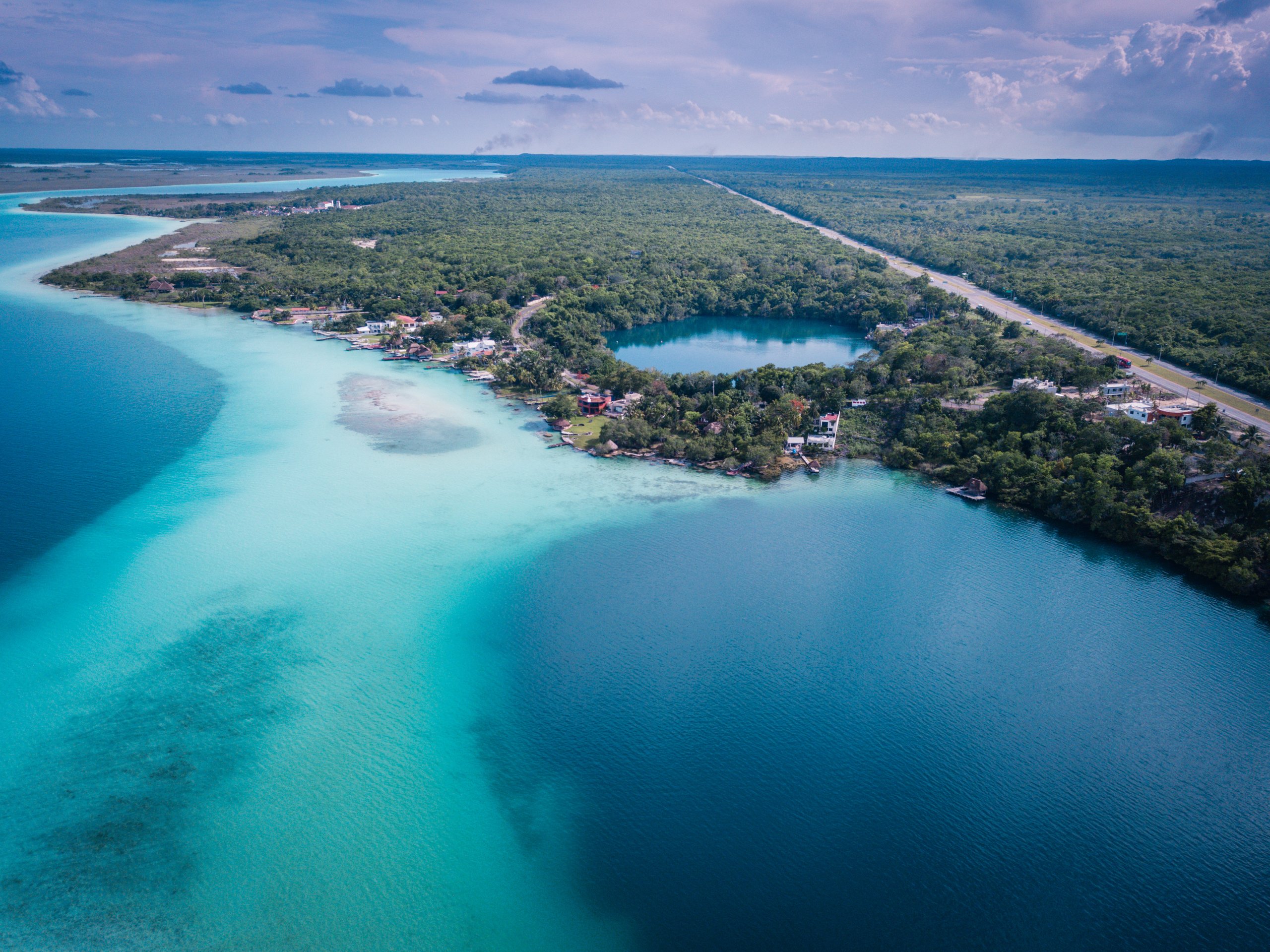
Bacalar depends on no surface rivers to feed it. Its water rises from below: the Yucatán Peninsula is a vast slab of limestone riddled with underground rivers, and the lagoon is one of the places where that system breaks the surface. Springs and cenotes — natural wells opened in the rock — supply it with water filtered through stone over many years, which is where its extraordinary clarity comes from. Several of those cenotes open within the body of the lagoon itself, deep shafts ringed by shallow flats, while others line its shores. More than an isolated lagoon, Bacalar is the visible face of an immense hydrological network running beneath the jungle.
That condition explains two important things. The first is the quality of the water: arriving filtered through rock, carrying very few nutrients and sediments, it lets light travel cleanly and allows the water's colors to reach the intensity that made Bacalar famous. The second is its vulnerability: a lagoon fed from underground renews itself slowly, and everything that happens in its basin — whatever gets built, spilled, or stirred up — sooner or later ends up in the water. Understanding the lagoon as a system, and not just as scenery, is the first step to experiencing it well.
The Essentials: Rapids, Cenotes, and the Pirate Channel
If one place sums up the lagoon, it is Los Rápidos, near the southern end. There the channel narrows and the water flows with a gentle, steady current over a bed studded with stromatolites, those living structures built by microorganisms over thousands of years. Letting the current carry you, floating unhurried down a crystal-clear channel flanked by mangroves, is one of the most serene experiences southeastern Mexico has to offer. The rule is simple and admits no exceptions: float down the center of the channel, without touching or stepping on the stromatolites along the edges — they are precisely what makes this place unique.
The cenotes are the other great chapter. The most celebrated is Cenote Azul, a shaft nearly 90 meters deep whose almost ink-dark blue contrasts with the turquoise shallows surrounding it; within the lagoon itself, other deep mouths open up, recognizable from the surface as sudden dark patches in the middle of clear water. Swimming over the rim of a cenote, where the shallow bottom drops abruptly into half-light, produces a gentle vertigo you never forget. They are also the most visible reminder that the lagoon is connected to the underground river system of the entire peninsula.
Toward the north, the pirate channel is the most photographed spot: a passage of sandy shallows and almost unreal turquoise water, whose name recalls the colonial era when pirates slipped through these waters to raid Bacalar — a story still told by the fort of San Felipe in town. And at the opposite end lies Xul-Há, the lagoon's southern terminus, quieter and less visited, where the water keeps a stillness all its own. Traveling the full length of the lagoon, from the northern shallows to the calm of Xul-Há, is the best way to understand that this is not one landscape but many, linked together.
How to Navigate the Lagoon with Respect
How you move across the lagoon matters as much as the places you visit. The best options are boats without engines — sailboat, kayak, paddleboard, canoe — or electric-powered craft, which glide along in silence without spilling fuel. This is not merely an aesthetic preference: gasoline engines churn up sediment from the bottom, leave residues in the water, and fill with noise a place whose greatest luxury is precisely its silence. A sailboat riding the afternoon wind or a kayak at dawn also offers something no speedboat can: time to watch the water change color beneath the hull.
The second rule concerns your skin. Conventional sunscreens and tanning lotions release chemicals that damage the lagoon's microbial life and cloud the water, so the right approach is to enter without sunscreen, protect yourself with long sleeves, a hat, and shade, and save the sunblock — only genuinely biodegradable formulas, if any — for after you have left the water. It may seem a minor detail set against a 42-kilometer body of water, but multiplied by thousands of visitors, that detail becomes one of the main threats to the lagoon's balance.
The third rule protects the oldest living things here: stromatolites are never to be touched, stepped on, or used as a perch to rest or pose for a photo. Nor should you drop anchor on the bottom or wade around stirring up sediment, which, once suspended, smothers life on the lagoon bed and dulls the colors. None of this takes away from the enjoyment; on the contrary, it gives it order. Choosing responsible operators — ones who go slowly, respect the delicate zones, and explain what you are seeing — is the difference between consuming the lagoon and truly getting to know it.
A Beauty That Rests on a Delicate Balance
Bacalar's stromatolites deserve a moment of their own. They are structures built by communities of microorganisms that precipitate minerals layer upon layer, and they belong to the lineage of the oldest life forms on Earth: organisms like these were responsible, billions of years ago, for filling the planet's atmosphere with oxygen. Bacalar's have been growing for millennia at a pace so slow that any damage is, on a human scale, irreversible. That a lagoon both inhabited and visited still holds living colonies of this kind is a global rarity — and it is also the deeper reason the lagoon's rules are not whims but conditions of survival.
The balance that sustains them is the same one that sustains the colors: water with very few nutrients, a light-colored bottom, abundant sunlight. That balance breaks easily. Excess nutrients — untreated sewage, fertilizers, soaps — cloud the water and favor organisms that crowd out the stromatolites; sediment churned up by propellers and anchors dims the transparency; clearing the vegetation along the shores strips away the natural filter that protects the lagoon from whatever runs off the land. Bacalar has seen episodes in which the water temporarily lost its color after seasons of storms and human pressure, and those episodes are a warning worth taking seriously.
Protecting the lagoon is neither a decorative gesture nor a passing trend: it is the only way to keep alive the very thing that draws everyone here. The good news is that this care is within reach of anyone who visits or lives nearby: travel without combustion engines, enter the water free of chemicals, insist on responsible management of water and vegetation, and treat the lagoon floor as what it is — a living organism. A lagoon that renews itself slowly demands visitors and neighbors who think slowly too, with their eyes on decades rather than seasons.
Life Around the Lagoon
The lagoon does not stand alone: around it revolves a life that weaves together town, jungle, and an entire region in transformation. The town of Bacalar, a Pueblo Mágico, preserves a human scale that has grown scarce along the Mexican Caribbean: low houses, the fort of San Felipe overlooking the water, restaurants and cafés without pretense, markets and workshops run by people who came from far and wide, drawn by the calm. From the lagoon's southern end, the town is about 15 minutes away — close enough to head out for dinner on a whim, far enough that its bustle never crosses the water. Chetumal, the state capital, with its airport and services, is 30 to 40 minutes away.
Getting here keeps getting easier. The Tren Maya operates a station in Bacalar, Tulum's international airport now receives flights and shortens the approach from the north, and Cancún's airport lies about four and a half to five hours away by road for those who prefer to drive the full coast. Add to that the public opening of Ichkabal, a large-scale Maya archaeological site a short distance from the lagoon, which lends historical depth to a region that for decades was little more than a rumor among travelers. Southern Quintana Roo has stopped being remote without ceasing to be tranquil, and that middle ground is precisely its value.
Around the water, daily life keeps a rhythm of its own: sunrises over the lagoon that make waking early worthwhile, afternoons of steady wind the sailboats put to good use, dark nights where the stars are still visible. It is a life that turns around a body of water serving as town square, gym, landscape, and barometer all at once: when the lagoon is well, so is everything else. That is why those who stay to live here almost invariably end up becoming its most devoted guardians.
The South Shore: The Most Serene Way to Live the Lagoon
If the lagoon has an intimate side, it is the south. There the water reaches its deepest tones, the current runs toward Los Rápidos and Xul-Há, and the shores keep a silence the north is gradually losing. It is also the stretch best connected to practical life: a quarter of an hour from town, a good half hour from Chetumal and its airport, with the Tren Maya and the federal highway as the region's arteries. Those who want not merely to visit the lagoon but to build a long-term relationship with it — returning every season, or staying for good — tend to end up looking toward this south shore, where it is still possible to live the water without the crowds.
It is on that south shore that The Reserve Bacalar is taking shape, a private residential community conceived out of respect for the lagoon: an international-class hotel immersed in rivers created within the development, a Day Club with direct access to the water for sailing, swimming, and watching the sunset, Branded Residences, and lots from 200 square meters for those who want to build their own version of this life. It is not a promise of spectacle but of continuity: the lagoon first, and around it a community that understands it as its greatest asset. Getting to know Bacalar Lagoon is the beginning; learning to care for it — and perhaps staying on its shore — is the natural consequence.
Frequently asked questions
Where is Bacalar Lagoon and how do you get there?+
It lies in southern Quintana Roo, Mexico, near Chetumal, the state capital, which is 30 to 40 minutes away and has an airport. The Tren Maya operates a station in Bacalar, Tulum's international airport shortens the trip from the north, and Cancún's airport is about four and a half to five hours away by road.
Is Bacalar Lagoon freshwater or saltwater?+
It is freshwater. The lagoon is fed by the Yucatán Peninsula's system of underground rivers and cenotes: its water rises from below, filtered through limestone, which is where its exceptional clarity comes from. Although its colors evoke the Caribbean, it is not the sea; it is an inland body of water about 42 kilometers long.
What is there to do at Bacalar Lagoon?+
The essentials are floating down Los Rápidos among stromatolites, swimming over the mouth of Cenote Azul and other cenotes that open within the lagoon, crossing the turquoise shallows of the pirate channel, and reaching Xul-Há at the southern end. The best way to navigate it is by sailboat, kayak, paddleboard, or electric boat.
Can you swim in Bacalar Lagoon?+
Yes, and it is one of its great experiences. What matters is entering without conventional sunscreen — its chemicals harm the lagoon's life — protecting yourself with clothing and shade, never touching or stepping on the stromatolites, and not stirring up the sediment on the bottom. With those simple rules, swimming in its clear fresh water is safe and memorable.
What are Bacalar's stromatolites and why can't you touch them?+
They are living structures formed by microorganisms that deposit minerals layer upon layer over thousands of years, related to the oldest life forms on Earth. They grow so slowly that any damage is irreversible on a human scale. Touching them, stepping on them, or anchoring on top of them destroys them, which is why at Los Rápidos and throughout the lagoon the rule is to observe them without contact.
Live Bacalar front-row
Discover The Reserve, a luxury community in the south of the Lagoon of Seven Colors.
Discover the project