Nature
The Mangroves of Bacalar: The Living Filter That Keeps the Lagoon Turquoise
Without mangroves there would be no seven colors. Here is how this amphibious forest filters the water, raises the lagoon's life and shelters the stromatolites, and why it must never be disturbed.
A forest that grows with its feet in the water
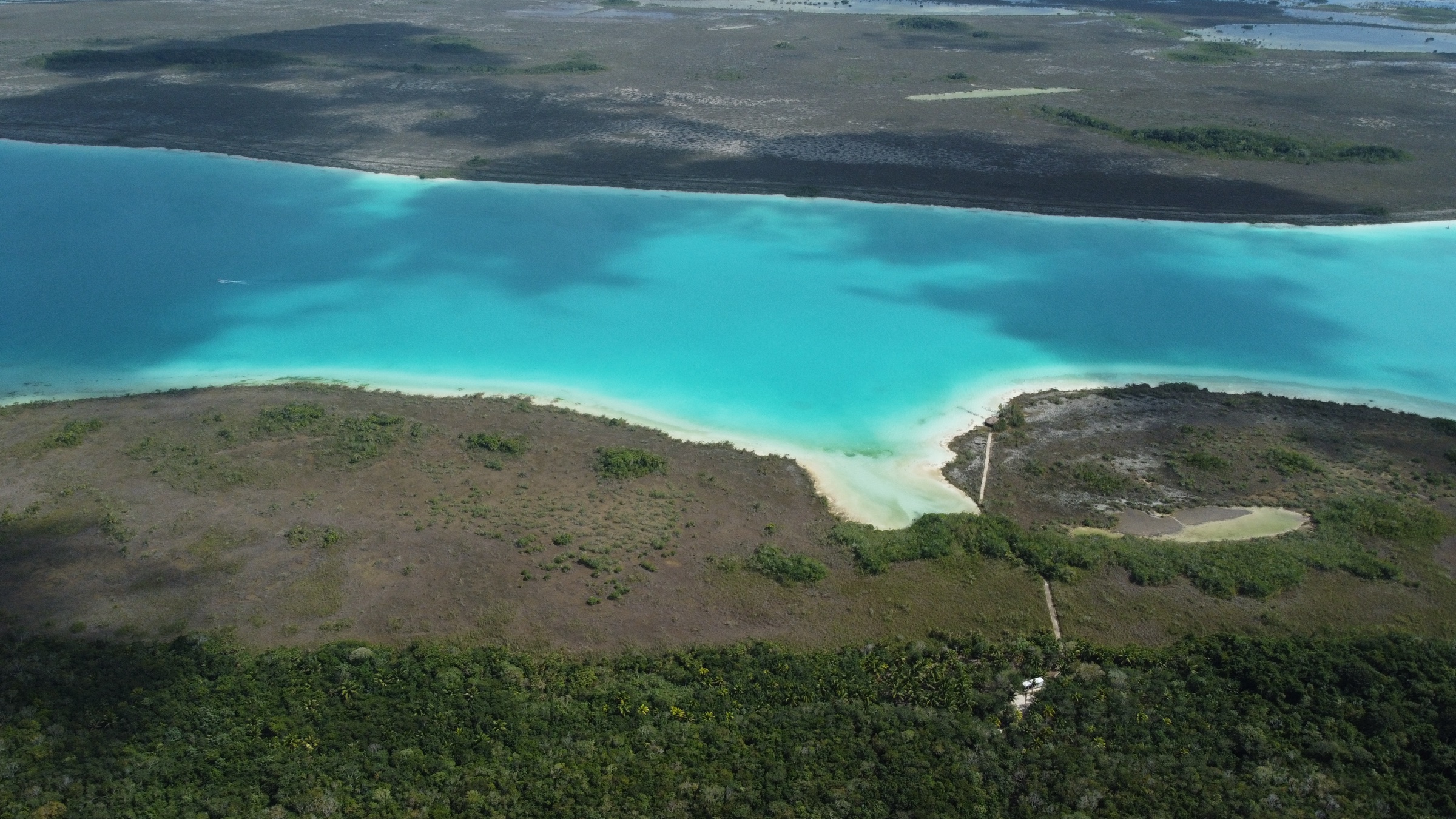
Wrapping almost the entire shoreline of the Lagoon of Seven Colors grows a quiet, tenacious green belt: the mangrove. Unlike the jungle that rises inland, these trees have solved an extraordinary problem, living with their roots permanently submerged in water. Along the shores of Bacalar three species mainly share the ground according to depth and salinity: the red mangrove (Rhizophora mangle), recognizable by its stilt-like roots that plunge into the water; the black mangrove (Avicennia germinans), which breathes through slender appendages that rise from the mud; and the white mangrove (Laguncularia racemosa), which occupies the slightly higher and drier ground.
These roots that so often go unnoticed are, in fact, the ecological infrastructure of the entire lagoon. They form a submerged tangle that holds the sediment of the bottom and the bank in place, keeps waves and rainfall from washing soil into the water, and creates a zone of calm where particles settle instead of clouding everything. It is the difference between a shoreline that crumbles and one that holds itself together.
In Bacalar the mangrove is not a detail of the landscape, it is the condition that makes the landscape possible. The turquoise color that made it famous, the millennia-old stromatolites, the abundance of fish and snails: all of it depends, in large part, on this amphibious forest remaining standing and undisturbed.
The living filter that keeps the water clear
Bacalar's transparency is neither coincidence nor magic, it is chemistry and biology working together. The lagoon is an oligotrophic system, meaning it is naturally poor in nutrients and suspended organic matter. The water that feeds it does not arrive through surface rivers but seeps through the limestone bedrock of the peninsula, which acts as a giant strainer and delivers it exceptionally clean and rich in calcium carbonate. That scarcity of nutrients is, paradoxically, its greatest asset: it is what allows light to reach the bottom and reveal the full range of blues.
This is where the mangrove acts as a second filter. Its roots and soils trap the sediment that washes down from higher ground and absorb the excess of nutrients, above all nitrogen and phosphorus, before they reach the water body. Researcher Luisa Falcón, of UNAM's Institute of Ecology, has pointed precisely to this absorption of excess nutrients as one of the mangrove's critical functions for the lagoon's health. When that filter works, the water stays nutrient-poor, clear and turquoise.
When the filter is removed, the opposite happens. Without mangroves, rain washes soil, organic matter and agrochemicals straight into the water. The nutrients fuel the growth of microorganisms and algae, sediment clouds the water column, light stops reaching the bottom, and the seven colors fade. Bacalar's turquoise is, at heart, the visible result of a system that keeps itself clean, as long as it is allowed to do so.
The lagoon's nursery
Among the roots of the mangrove, life finds refuge. That submerged, tangled structure is one of the most productive habitats on the planet: it offers shade, hiding places from predators and abundant food. This is why mangroves act as a natural nursery, juvenile fish, crustaceans and snails spend their most vulnerable stages there, protected until they are large enough to venture into open water.
In Bacalar this function sustains much of the lagoon's food chain. Among its emblematic inhabitants is the chivita (Pomacea flagellata), a freshwater snail that grazes over the sediment and is a key piece of the system's balance, so tied to local culture that it lends its name to regional dishes. Alongside it live small fish, larvae and a microfauna that thrive only in clean water and healthy vegetation.
This biological richness is also why harming the mangrove sets off a chain reaction. It is not just a row of trees that is lost, it is the entire nursery and, with it, the generations of wildlife that depend on those roots to survive. A mass die-off of chivita snails, like the one documented after the 2020 crisis, is the visible signal of a system whose breeding refuge has been broken.
Mangroves and stromatolites: an ancient alliance
Bacalar holds one of the largest freshwater microbialite formations in the world, popularly known as stromatolites. They are structures built by communities of microorganisms, above all cyanobacteria, that precipitate calcium carbonate and form living reefs which grow very slowly, millimeter by millimeter, over thousands of years. They are direct relatives of the earliest life forms that oxygenated the Earth, which is why they are called living rocks.
Stromatolites and mangroves depend on one another. Studies of Bacalar's microbiome have described how the microbialites of the southern lagoon associate with mangrove roots and host nitrogen-fixing bacteria that enrich the system naturally. At the same time, the mangrove keeps the water clear and nutrient-poor, the exact conditions the stromatolites need to keep growing. Too many nutrients and sediment suffocate them, smother them in algae and halt their growth.
This is the deeper reason the mangrove must not be disturbed. It is not just a pretty tree on the shore: it is what sustains a geological and biological phenomenon thousands of years in the making. Tearing out the mangrove to open up a view or to build closer to the water is the same as removing the system that keeps the stromatolites alive. Once suffocated, they do not recover within a human lifetime.
What the crisis taught and what we must protect
In June 2020 Bacalar issued a warning that is hard to forget. Tropical Storm Cristóbal unleashed intense rains and, according to reports, damaged around 30 kilometers of mangrove. Without that barrier that once slowed the currents, the water dragged loose soil from deforested areas, organic matter and agrochemicals into the lagoon. The lagoon lost its turquoise and turned brown and greenish for nearly two years. It was not a whim of the weather, it was the consequence of years of pressure compounded by a weakened mangrove.
The lesson from the scientists who study Bacalar, at institutions such as UNAM, ECOSUR and the citizen and scientific restoration councils, points in a single direction: the path to conserving the seven colors runs through restoring the mangrove, protecting the riverbank vegetation and preventing contamination and irregular settlements along the shore. Allowing the amphibious forest to grow and remain intact is, quite literally, letting the lagoon take care of itself.
For anyone who visits, lives or builds near Bacalar, the principle is clear and simple: the mangrove is off-limits. It is not cleared for a view, not filled in to bring a structure closer to the water, not crossed by motorboats over its roots. Keeping a strip of mangrove and native vegetation along the shore, treating all wastewater and keeping development at a distance from the waterline is not a restriction, it is the only way for the turquoise to keep existing for the generations to come.
Frequently asked questions
Why do mangroves keep Bacalar's water blue and clear?+
Because they act as a living filter. Their roots and soils trap the sediment that washes down from higher ground and absorb the excess of nutrients, above all nitrogen and phosphorus, before they reach the lagoon. This keeps the water nutrient-poor and very clear, the condition that lets light reach the bottom so the seven colors appear. Without mangroves, rain washes soil and nutrients into the water, algae grow, sediment clouds it, and the turquoise fades.
How are mangroves connected to the stromatolites?+
It is a relationship of mutual dependence. The stromatolites in the southern part of Bacalar associate with mangrove roots and with nitrogen-fixing bacteria that enrich the system. In turn, the mangrove keeps the water clear and nutrient-poor, the exact conditions these living rocks need to keep growing. If the mangrove disappears, sediment and excess nutrients suffocate the stromatolites and halt a growth that took thousands of years.
What happened to the lagoon in 2020?+
In June 2020 Tropical Storm Cristóbal brought intense rains and, according to reports, damaged around 30 kilometers of mangrove. Without that natural barrier, the water dragged soil from deforested areas, organic matter and agrochemicals into the lagoon. Bacalar lost its turquoise color and looked brown and greenish for nearly two years, alongside a mass die-off of the chivita snail. It was a direct demonstration of what happens when the mangrove is weakened.
Why must the mangrove never be cut or disturbed?+
Because it is the infrastructure that holds the whole lagoon together: it filters the water, anchors the shore against storms, serves as a nursery for fish and snails, and keeps millennia-old stromatolite colonies alive. Clearing it for a view or filling in to build closer to the water breaks that system, and once lost it takes decades or longer to recover. Keeping a strip of mangrove and native vegetation, treating wastewater and staying back from the waterline is the only way to protect the seven colors.
Live Bacalar front-row
Discover The Reserve, a luxury community in the south of the Lagoon of Seven Colors.
Discover the project