Investment
How to Buy Land in Bacalar: The Complete Guide to Investing with Certainty
A complete guide to buying land for sale in Bacalar: documents to check, ejido vs. private property, lagoon zones, and the notary closing process.
Why Bacalar Draws Land Buyers
There are few places in Mexico where land makes as clear a case for itself as it does in Bacalar. The Lagoon of Seven Colors stretches along some 42 kilometers of freshwater, shifting from turquoise to deep blue, its shores home to millennia-old stromatolites—some of the oldest living formations on the planet. It is a landscape that cannot be replicated or manufactured, and that scarcity is at the root of everything: anyone searching for land for sale in Bacalar is not just buying square meters; they are buying the chance to live beside one of the most extraordinary bodies of water on the continent, in a destination that also holds the Pueblo Mágico designation.
Adding to that natural appeal is a level of connectivity Bacalar has never had before. The Tren Maya is now running with a station in Bacalar, Tulum's international airport receives domestic and international flights, and the archaeological site of Ichkabal—one of the most imposing Maya cities in the region—has opened its doors to the public. Chetumal, the state capital, with its own airport, sits 30 to 40 minutes away by road, and Cancún's airport roughly four and a half to five hours. For a destination that spent decades as southern Quintana Roo's best-kept secret, this infrastructure changes the rules: getting there keeps getting easier, and demand for land reflects it.
The profile of those deciding to buy land in Bacalar is more diverse than it might seem. There are those looking to build a lagoon-front retreat; those who want to get ahead of the growth of a destination only beginning to develop in an orderly way; and those who simply want to secure a lasting asset in a region where land with access to the water is, by definition, finite. They all share the same question: how to buy well. Because in a young market, with offerings of every kind and widely varying degrees of legal certainty, the difference between a great purchase and a costly problem lies in the paperwork, not the scenery. That is what this guide is about.
What to Check Before Buying Land in Bacalar
Start with the deed. A parcel worth buying comes with a public deed recorded in the Public Registry of Property, establishing who owns it and under what conditions. Always request a copy and obtain—or have the notary obtain—a certificate of no liens: that document confirms the property carries no mortgages, seizures, litigation, or restrictions on ownership. If the seller is reluctant to show the deed, offers "paperwork in process," or proposes signing private contracts "in the meantime," treat it as a serious red flag. In real estate, what is not recorded in the Public Registry simply does not exist as far as third parties are concerned, and no attractive price makes up for a property that cannot be titled.
The second filter is zoning. The municipality of Bacalar has urban planning instruments that define what can be built in each zone, at what density, and under what restrictions—especially relevant for parcels near the lagoon, where additional environmental considerations apply. Before committing, verify that the property's land-use designation is compatible with your project: a residential lot is not the same as one zoned for tourism or conservation. A spectacular piece of land where you cannot build what you envision is a bad purchase, no matter how cheap it looks. This verification is done with the municipal authorities, and it is worth getting resolved in writing before signing any preliminary purchase agreement.
Third: access and utilities. Ask how you reach the property in the rainy season, whether the road is public or crosses third-party land, and how far away electricity and water are, because bringing utilities to a remote parcel can cost more than the land itself. And fourth—perhaps most important of all—who is selling. Confirm that the person signing is actually the owner named in the deed, or holds a valid and sufficient notarized power of attorney. Be wary of intermediaries who cannot document their relationship to the owner, and of "representatives" of unsettled estates. In Bacalar, as in any growing market, most problems do not come from the land: they come from whoever is selling it.
Ejido or Private Property: The Distinction That Defines Everything
Much of the land surrounding Bacalar has ejido origins. The ejido is a form of communal ownership born of Mexico's agrarian reform: the land belongs to a community, and ejido members hold rights over their parcels, but those rights do not amount to full private ownership. The market abounds with ejido parcels offered at prices notably lower than private property, almost always through a "transfer of rights" signed before witnesses or, at best, before the ejido's governing board. The low price has a precise legal explanation: what you are buying there is not land—it is an expectation.
It is worth saying plainly: a transfer of ejido rights is not a deed, cannot be recorded in the Public Registry of Property, and protects the buyer neither against third parties nor against the ejido itself. For an ejido parcel to be legally sold as private property, it must first go through a regularization process and the adoption of full ownership title, which depends on the ejido assembly and can take years—or never happen at all. Anyone who buys before that step is complete is left in a fragile position: they cannot obtain a deed, cannot access financing, and their investment rests on the good faith of people who are under no legal obligation to them. There are stories of ejido purchases that ended well; there are many more that did not.
Private property, by contrast, offers the complete path: a public deed executed before a notary, registration in the Public Registry, a certificate of no liens, and the freedom to sell, bequeath, or develop without asking an assembly's permission. That is why the first question about any parcel in Bacalar should be its ownership regime—before price, view, or location. If the answer is "ejido," the transaction demands specialized counsel and a risk tolerance most buyers protecting family wealth have no reason to take on. If the answer is "private property with a deed," the rest of the review becomes an orderly, predictable process.
The Lagoon's Zones: Where to Look and Why the South Stands Out
Bacalar's lagoon is long—about 42 kilometers—and its shoreline is far from uniform. The town area concentrates the waterfront promenade, the swimming spots, the boutique hotels, and the life of the Pueblo Mágico; land there is scarce, waterfront parcels are few, and the supply tends to be fragmented, with small lots wedged between existing buildings. Toward the north of the lagoon, the shoreline grows more isolated, with longer access routes and less consolidated services. Both zones have their logic, but they share a challenge: growth has been largely spontaneous, and it shows in the mix of uses, construction quality, and widely varying legal situations.
The south of the lagoon tells a different story. At that end, where the water narrows toward Xul-Há, the shoreline preserves large tracts now being developed in a planned way, with a low-density residential and tourism vocation. The location is strategic: the town of Bacalar is about 15 minutes away, Chetumal—with its airport and all the services of a state capital—30 to 40 minutes, and the highway connection to the rest of the peninsula is direct. For anyone buying with construction and long-term value in mind, the south offers what the central zone no longer can: scale, order, and the chance to enter a setting designed from the outset rather than improvised along the way.
The Purchase Process Step by Step, with a Notary
Once you have chosen the parcel and reviewed the points above, the formal process is simpler than people fear. It typically begins with an offer and, in many cases, a preliminary purchase agreement that sets the price, deadlines, and conditions, accompanied by a deposit. That agreement should make the transaction conditional on all documentation being in order: it is your due diligence window. In parallel, you choose the notary public, because in Mexico a real estate sale is only perfected—and only enforceable against third parties—once it is formalized in a public deed before a notary. The buyer has the right to choose the notary; exercise it, preferably with a notary from Quintana Roo who is familiar with the local registries and procedures.
The notary then does the fine-grained work: requesting an updated certificate of no liens, verifying the identity and legal capacity of the parties, confirming the property is current on its property tax, arranging the appraisal, and calculating the transaction's taxes—including the real estate acquisition tax owed by the buyer—along with registration fees and their own fees. On signing day, both parties appear to execute the deed, the price is settled, and the notary handles recording the new deed in the Public Registry of Property. Only once that registration exists is the purchase truly closed. Keep your certified copy of the deed: it is the document that proves your ownership.
If the buyer is a foreigner, there is one additional step: Bacalar sits within the so-called restricted zone—the strip near borders and coastlines where Mexico's Constitution limits direct foreign ownership—so the acquisition is structured through a bank trust or, in certain cases, through a Mexican company. It is a standard procedure, one that the region's notaries and banks handle routinely, and it grants the foreign buyer full rights to use, enjoy, build on, and sell the property. Far from being an obstacle, it is a mechanism proven over decades in every beach destination in Mexico; it simply needs to be factored into the timeline and costs of closing.
Buying with Certainty: What the South of the Lagoon Offers
In the end, buying land in Bacalar comes down to one idea: the scenery is extraordinary almost anywhere on the lagoon, so the real difference between one purchase and another is certainty. Legal certainty—deed, registration, freedom from liens; planning certainty—clear zoning, resolved access and utilities; and certainty about your surroundings: knowing what will be built around your land over the next twenty years. That last one is the hardest to secure when buying isolated lots, and it is exactly what a master-planned development can guarantee by design, with regulations, infrastructure, and an overall vision that protects the value of every lot from day one.
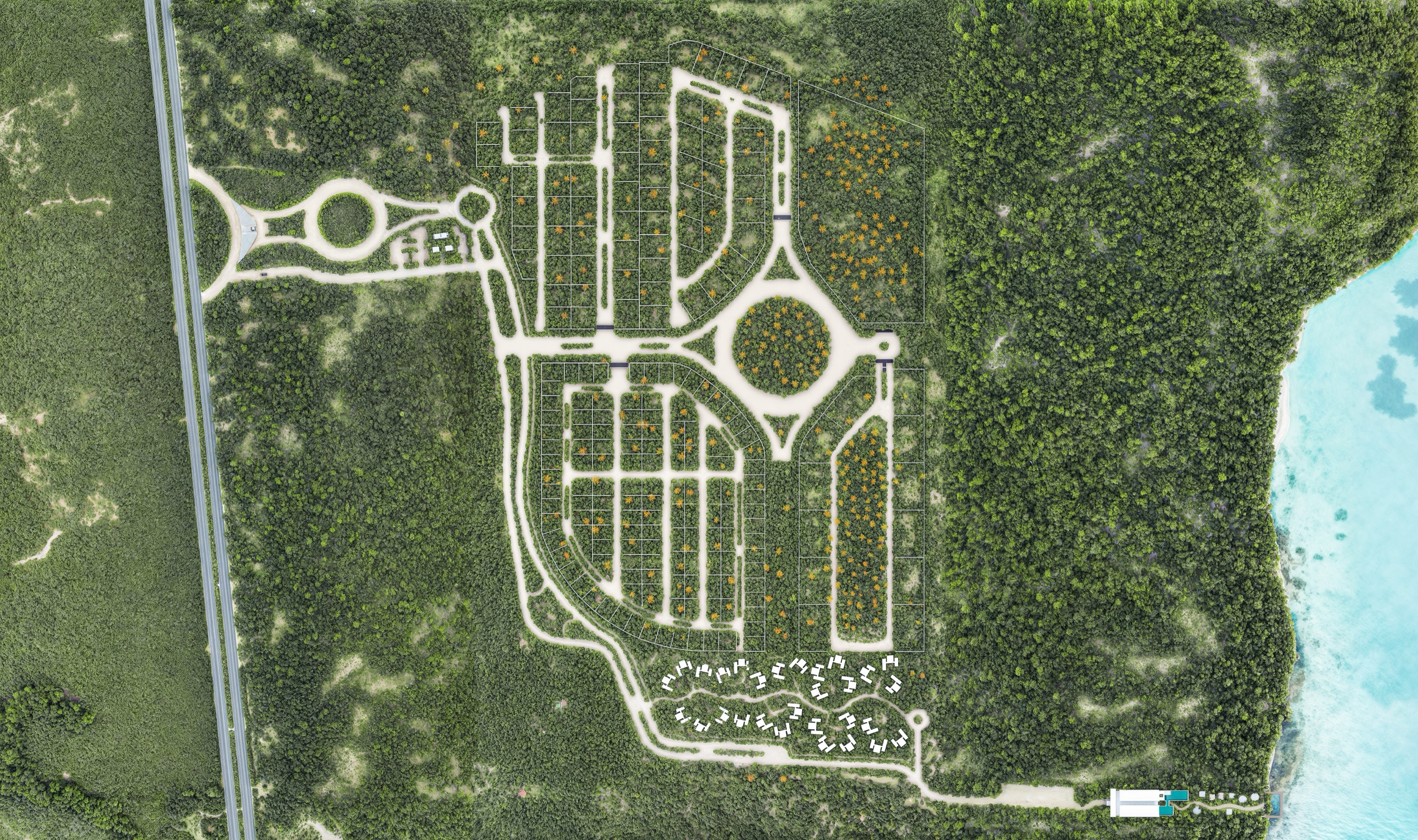
That is the logic behind The Reserve Bacalar, the private residential community taking shape on the south of the lagoon: lots held as private property, titled before a notary with complete legal certainty, starting at 200 square meters, within a planned community that integrates a world-class hotel immersed in rivers created within the development, a Day Club with direct access to the lagoon, and Branded Residences. For anyone who has read this guide, the appeal is obvious: everything you must verify when buying land in Bacalar—ownership regime, zoning, utilities, surroundings—comes resolved from the start. The lagoon supplies the beauty; a well-conceived project supplies the certainty. And that combination is, in southern Quintana Roo, the definition of a good purchase.
Frequently asked questions
Is it safe to buy ejido land in Bacalar?+
Buying ejido land through a transfer of rights carries high risk: that transfer is not a deed, cannot be recorded in the Public Registry of Property, and protects you neither against third parties nor against the ejido itself. It is only safe to acquire parcels that have already completed the full-ownership process and can be sold as private property before a notary. If the seller cannot prove this with documents, the prudent move is not to buy.
What documents should I review before buying land in Bacalar?+
At a minimum: the public deed recorded in the Public Registry of Property, a recent certificate of no liens, a zoning certificate compatible with your project, property tax receipts showing payments are current, and the seller's official ID—or a valid notarized power of attorney if a representative is signing. The notary will verify everything at closing, but it is wise to review it all before handing over any deposit.
Can a foreigner buy land in Bacalar?+
Yes. Bacalar lies within the restricted zone because of its proximity to the border and the coast, so foreigners acquire through a bank trust or a Mexican company. Both structures are legal, commonplace, and grant full rights to use, build, rent, and sell. Notaries and banks in Quintana Roo process them routinely as part of the closing.
Where is the best place to buy land in Bacalar?+
It depends on your goal. The center offers proximity to town but limited supply and fragmented lots; the north, more isolation and less consolidated services. The south of the lagoon, toward Xul-Há, stands out for its planned development and its proximity to town (about 15 minutes) and to Chetumal with its airport (30 to 40 minutes), making it especially attractive for building and for long-term value.
What additional costs come with titling land in Bacalar?+
Beyond the land price, the buyer typically covers the real estate acquisition tax, the registration fees at the Public Registry of Property, the appraisal, and the notary's fees. Amounts vary with the transaction value and current rates, so it is worth asking the notary for a detailed closing estimate before signing the preliminary purchase agreement.
Live Bacalar front-row
Discover The Reserve, a luxury community in the south of the Lagoon of Seven Colors.
Discover the project