Destination
Living in Bacalar Year-Round: Real Life Beside the Lagoon
Living in Bacalar year-round: small-town rhythm by the lagoon, community, services, internet, an honest look at the climate, and what to know before you move.
The rhythm of a town that lives facing the water
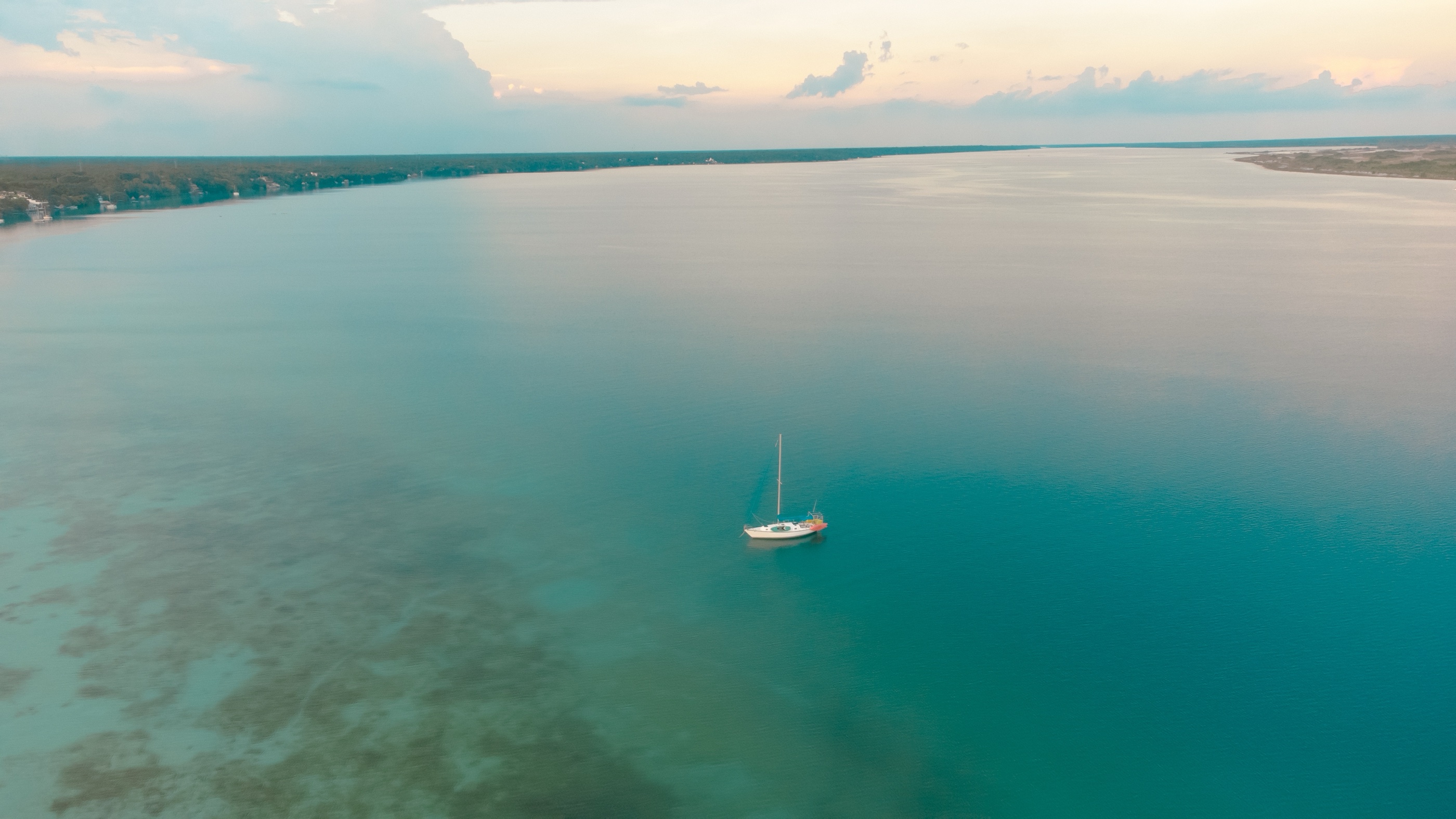
Spend a few days in Bacalar and you leave with the postcard: turquoise water, wooden docks, sunsets over the Lagoon of Seven Colors. Stay for good and you discover something else, deeper and harder to photograph: a rhythm. Bacalar is still a town — a Pueblo Mágico, no less — and it works like one. Distances are measured in minutes, not hours of traffic; errands get done on foot; the day starts early, with the sun, and ends early too. The lagoon — some 42 kilometers of freshwater — sets the shape of daily life: some swim before work, some paddle at sunset, some simply plan their week around the hours when the water is at its stillest.
That rhythm is, for many, the real reason to move. You don't come to Bacalar for urban convenience; you come for time — the time you get back when you cut out commutes, noise, and hurry. The town sits about fifteen minutes from the lagoon's southern end, where the landscape turns wilder and quieter, and that closeness makes possible something rare: living surrounded by nature without giving up town life, with its market, its family-run eateries, its plazas. The adjustment isn't instant — you do miss the city, and we'll be honest about that — but those who stay tend to agree that the change of pace was exactly what they came looking for.
A local community with an international accent
Bacalar has deep roots: families who have been here for generations, fishermen, shopkeepers, teachers, tour guides who know the lagoon the way you know your own home. Over that foundation, an international layer has been weaving itself in over recent years: Europeans, South Americans, Canadians, and Mexicans from other cities who came passing through and decided to stay. The result is a town where a home-style eatery that has fed the neighborhood forever shares the block with a specialty coffee shop run by a French couple, and where hearing three languages at the market on a Saturday morning is nothing unusual.
For newcomers, that mix makes for a much softer landing. Informal groups and resident networks share everything from plumber recommendations to yoga classes, and at the town's scale, faces become familiar fast. At the same time, Bacalar is not — and doesn't try to be — an expat bubble: social life runs through the town's festivals, local tournaments, the church, the kids' school. Truly integrating takes willingness, Spanish, and respect for a community that was here long before the destination boomed. Arrive with that attitude and you'll find something scarce in big cities: neighbors who know your name.
Everyday services: market, healthcare, and schools
The practical question comes up quickly: can you lead a normal life in Bacalar? The short answer is yes, with small-town caveats. For daily shopping there's the market, grocery stores, tortilla shops, fruit stands, and chain supermarkets in Bacalar itself; for bigger or more specialized purchases, Chetumal — the state capital — is thirty to forty minutes away on a well-kept highway, with shopping malls, department stores, and everything you'd expect of a capital city. Many residents make a run to Chetumal every couple of weeks and handle the rest in town, where local producers of bread, cheese, vegetables, and fish are thriving.
On healthcare, let's be clear: Bacalar has doctors' offices, pharmacies, and basic medical care sufficient for everyday needs, but hospitals with specialists, full laboratories, and higher-complexity care are in Chetumal. For a family, that means primary care within reach in town and a short drive for everything else; many residents carry medical insurance that works with the capital's private hospitals. In education, the town has public schools and small private options, including alternative-education projects that have arrived with the new families; for a broader range of schools, once again, Chetumal fills the gap. None of this is Mexico City, and it doesn't try to be: it's the reasonable infrastructure of a town with a capital close by.
Internet, remote work, and the south's new connectivity
A good share of those moving to Bacalar today work remotely, so the internet question is a fair one. Here's the real picture: the town and several stretches of the lagoon's shore have fiber-optic service from commercial providers, and where fiber doesn't reach — more remote lots, the southern shore, jungle areas — Starlink-style satellite service works and is already common among residents. The prudent thing is not to promise speeds, since they vary by area and provider, but it is fair to say that today you can hold video calls, upload files, and work online from Bacalar — something that just a few years ago demanded real compromise. Many people run two services as a backup, a sensible practice anywhere your livelihood depends on the connection.
Digital connectivity comes on top of the physical kind, which has changed the equation for southern Quintana Roo. The Tren Maya is up and running and Bacalar has its own station; Tulum's international airport is operating and shortens the trip from several destinations; Chetumal keeps its airport thirty to forty minutes away, and Cancún, with its enormous range of flights, is four and a half to five hours by road. For a full-time resident, this means something concrete: living in a quiet town without being cut off, hosting visitors without logistical odysseys, and traveling for work when needed. The lagoon's southern end, historically its most remote corner, is now the best-positioned area relative to these new routes: close to Xul-Há, to the Chetumal junction, and to the federal highway.
The climate, safety, and what you will miss
Let's talk frankly about the climate, because it's the factor that weighs most in the adjustment. Bacalar is the tropics: humid heat much of the year, a sun that demands respect, and a rainy season — summer into fall — with intense downpours, mosquitoes, and, as everywhere in the Caribbean, the possibility of tropical weather systems that must be tracked seriously. The winter months are a gift: mild days, cool nights, the lagoon in its best light. If you come from a cold climate, expect to need a full cycle of seasons to calibrate expectations; architecture helps enormously — high ceilings, cross-ventilation, shade — and the lagoon itself is the best air conditioning there is.
On safety, southern Quintana Roo keeps a character distinct from the state's massive tourist hubs to the north: small-town scale, communities where people know each other, a slower kind of tourism. You feel it in daily life, and it's one of the reasons so many families choose this area. Said with due prudence: no place is exempt, and the reasonable precautions you'd take anywhere apply here too; the difference lies in the everyday environment, which in Bacalar is still that of a quiet town.
And yes, there are things you will miss. The cultural calendar of a big city, chef-driven restaurants on a random Tuesday, deliveries within hours, a certain anonymity, the endless variety of everything. That's the real cost of living here, and it's better to accept it before moving, not after. Most of those who stay make peace with the trade: they swap an abundance of options for an abundance of time, and they discover that Chetumal, the Tren Maya, and the airports keep the city within manageable reach for whenever the nostalgia hits.
Living on the lagoon's south end: where the town ends and the silence begins
Within Bacalar there are many ways to live, and geography matters. The town concentrates the activity; the north shore, the boutique hotels; and the south — toward Xul-Há, where the lagoon narrows at its tip and the water reaches its deepest blues — holds the most untouched landscape: jungle, millennia-old stromatolites, sunrises without a sound. It's the area chosen by those who want to truly live in nature without straying far from town, about fifteen minutes away, or from Chetumal and its airport, just over half an hour. With Ichkabal open to the public and the Tren Maya running, the corner that was once the lagoon's best-kept secret has quietly become its most compelling place to put down roots.
There, on the lagoon's south end, The Reserve Bacalar is taking shape: a private residential community designed precisely for this year-round life, with an international-class hotel immersed in rivers created within the development, a Day Club with lagoon access, Branded Residences, and lots from 200 square meters for those who prefer to build at their own pace. It isn't a promise of a city by the water — quite the opposite: the infrastructure and services needed so that living in Bacalar doesn't mean giving up anything essential, on the stretch of the lagoon where silence still rules. If you've read this far and recognize yourself in this way of living, it's a good place to start imagining it.
Frequently asked questions
What is it like to live in Bacalar year-round?+
It's small-town life beside a freshwater lagoon some 42 kilometers long: an unhurried pace, short distances, a local and international community, and nature woven into daily life. Everyday needs are covered in town and more specialized ones in Chetumal, 30-40 minutes away. In exchange, you give up the cultural and commercial offerings of a big city.
Is the internet in Bacalar good enough for remote work?+
Yes, working remotely from Bacalar is possible. The town and several shoreline areas have fiber-optic service from commercial providers, and on more remote lots Starlink-style satellite service is already a common solution. Speeds vary by area and provider, so many residents combine two services as a backup for video calls and online work.
What medical services and schools does Bacalar have?+
Bacalar has doctors' offices, pharmacies, and basic medical care for everyday needs; hospitals with specialists and higher-complexity care are in Chetumal, 30 to 40 minutes away. In education, the town has public schools and small private options, including alternative programs, while Chetumal rounds things out with a broader range of schools.
Is Bacalar safe to live in?+
Southern Quintana Roo keeps a small-town character distinct from the state's massive tourist hubs to the north, with small communities where people know each other and a calm everyday atmosphere. As anywhere, the usual reasonable precautions apply; the difference lies in the scale and pace of the surroundings, which many families value when choosing this area.
How do you get to Bacalar and how connected is it?+
The Tren Maya is already running and Bacalar has its own station. Chetumal's airport is 30-40 minutes away, Tulum's international airport is now operating, and Cancún, with the largest range of flights, is 4.5 to 5 hours by road. This combination lets you live in a quiet town without being isolated or complicating visits and work travel.
Live Bacalar front-row
Discover The Reserve, a luxury community in the south of the Lagoon of Seven Colors.
Discover the project